Complex Means Interesting
Structure that rewards stronger observers
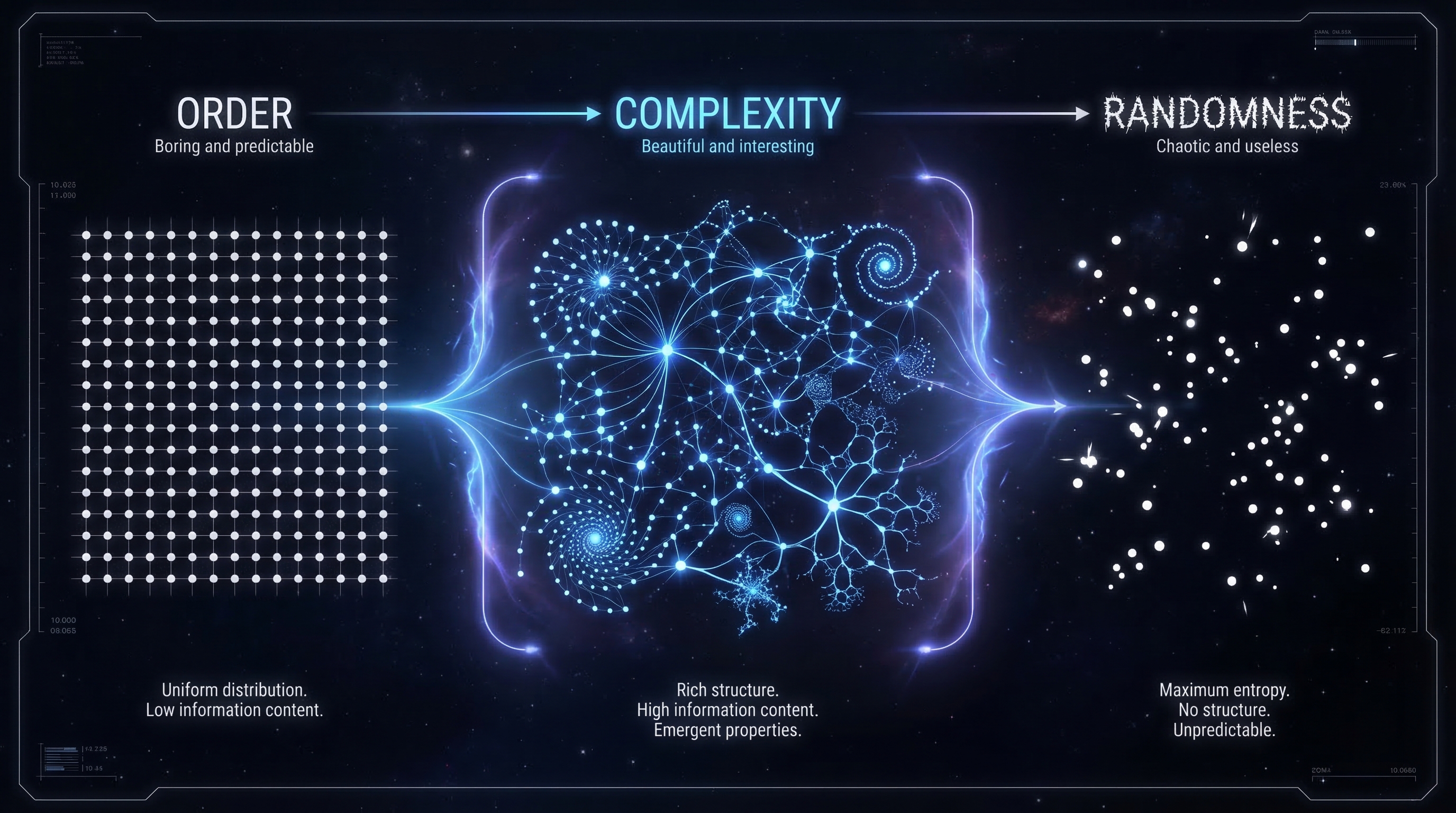
The Many Definitions of Complexity
There are many definitions of complexity. Entropy, Kolmogorov complexity, logical depth, statistical complexity. Some of them even contradict each other.
Yet intuitively we rarely struggle to recognize complexity when we encounter it.
Complex Means Interesting
My current intuition is simple. Complex means interesting. From an evolutionary perspective, interesting means something more precise. It signals that investing energy to understand a phenomenon may produce advantage.
Order is not interesting because there is nothing to gain. Pure randomness is not interesting because there is nothing to exploit. What we call complex sits exactly in between. It is structure that rewards stronger observers.
Complexity as Advantage
This intuition led me to explore a framework called Complexity as Advantage.
The idea is straightforward. Complexity is the performance gap between observers with different capabilities. A source is complex when better observers consistently outperform weaker ones. When everyone succeeds equally or everyone fails equally, complexity disappears.
This view connects complexity to regret, excess entropy, MDL, and logical depth, while producing measurable indicators that separate shallow, chaotic, and deep processes.
The Paradox of Complexity
There is also a small paradox hidden here.
If complexity is a signal of whether investment will pay off, then we need to know whether to invest before investing. This makes complexity less like an explicit metric and more like an internal heuristic. It must live inside fast intuitive cognition rather than deliberate reasoning. Perhaps this explains why complexity is so hard to define formally yet so easy to feel.