The Interference Alignment Lesson
Whenever I see a beautiful theoretical result with incredible scaling, I first look for the hidden contract.
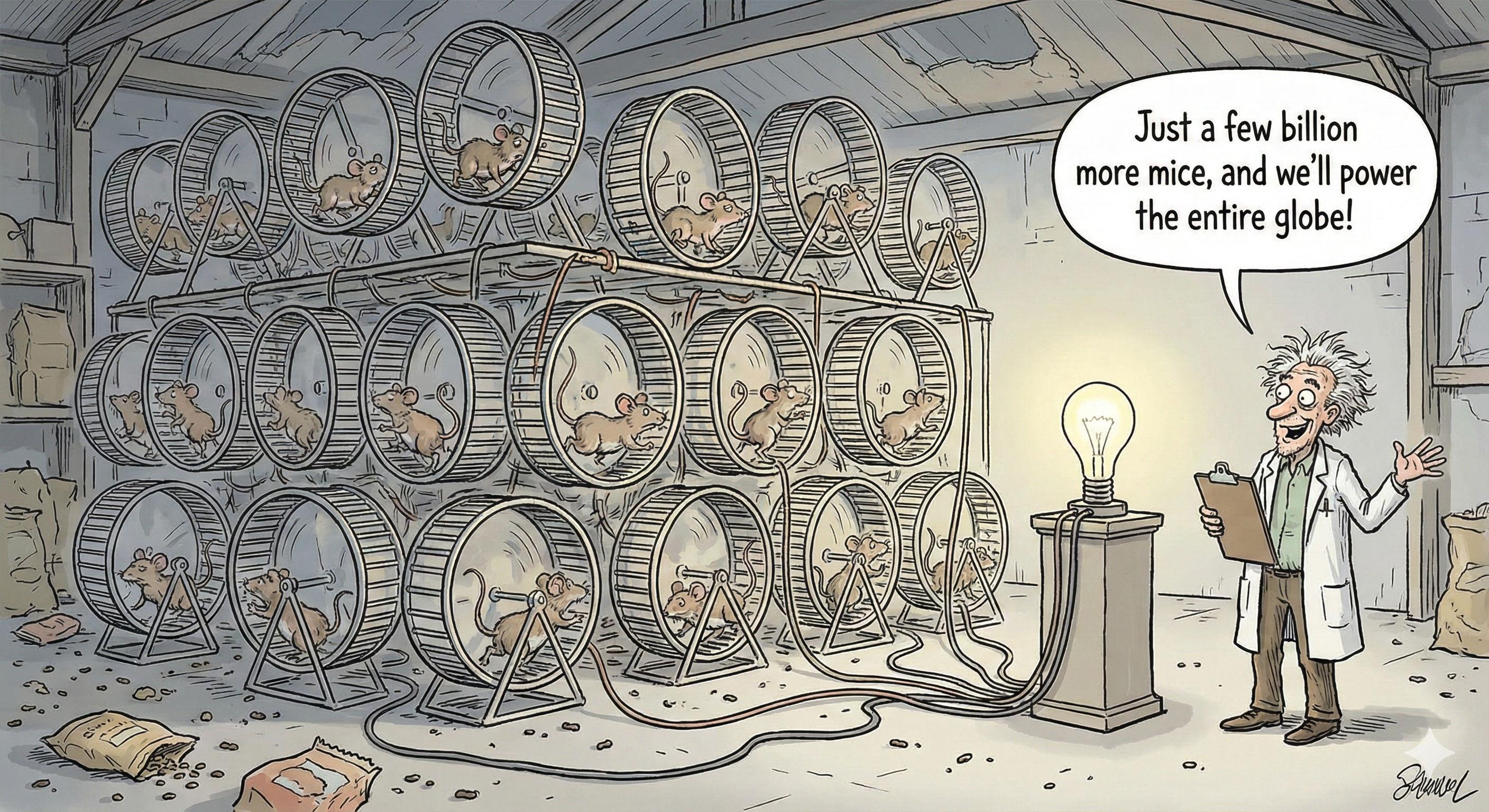
What is Interference Alignment?
Everyone knows what AI is but have you ever heard of IA?
Do you know Interference Alignment? For me, it’s a “story with a moral” that we lived through in the wireless research community almost 20 years ago. It’s a lesson about the gap between mathematical beauty and engineering reality.
The Shared Channel Problem
In wireless communication, the channel is a shared resource. When multiple users talk at once, signals don’t politely take turns, they add up. The receiver gets a mixture, and users become interference to one another.
The classical engineering approach is to separate users cleanly:
- TDMA: You get the whole channel, but only for a fraction of the time.
- FDMA: You get the whole time, but only a fraction of the frequency.
The math is brutal: as the number of users grows to infinity, everyone’s share goes to zero.
The Magical Promise
But in 2008, a seemingly magical idea appeared: Interference Alignment (Cadambe & Jafar). The promise sounded impossible: even with infinite users, each one could still get half of the global resource. Sounds like magic? The math actually worked out.
The intuition was brilliant: imagine there’s a subspace I care about (my signal) and a subspace I don’t care about. If we can force all interference from everyone else to align perfectly into the “don’t care” subspace, I can communicate interference-free in my half.
The promise was enormous. Spectrum is physics, you can’t just manufacture more of it. So, we tried to build it. And it worked! …At a small scale, in the lab. The vibe was: “We just need better engineering, and the world’s interference problem is solved.”
Reality Had Other Plans
But reality had other plans.
There is no such thing as a wireless channel that stays constant. It turns out that as you scale IA to more users, the required accuracy of Channel State Information (CSI) grows exponentially. At a certain point, the cost of synchronization explodes. Even for a “nice,” slowly varying channel, almost 100% of the bandwidth becomes overhead just to keep the alignment alive. The system collapsed under its own complexity.
The Lesson
The lesson I took from this: Sometimes something works perfectly on paper. There is no law of physics forbidding it. And yet, it fails in the real world. Not because the math is wrong, but because “engineering details” don’t just change the constants, sometimes, they break the scaling laws entirely.
Since IA, whenever I see a beautiful theoretical result with incredible scaling, I first look for the hidden contract: What must stay perfectly aligned? And what does it cost to keep it that way?